Circuit and receptacle selection
Confirm the RV input and intended use, then coordinate the supply, conductors, breaker and connection.

The right connection for your RV
A home RV connection should match the vehicle’s shore-power requirements and the place it will be parked. Mister Safety plans the circuit, receptacle, enclosure and route together, with the property’s capacity and required protection in view.
Defined installation estimates. Clear charges before paid diagnostic work.
A standard TT-30 RV supply is nominal 120 volts. A typical home NEMA 14-50 RV supply is nominal 120/240 volts. Matching an amp number or making a plug fit with an adapter does not verify the supply behind it.
Some 50A range and RV connections use the same NEMA 14-50 pattern. That shared shape does not establish whether an existing range circuit, location, condition or protection is suitable for an RV. A 30A dryer connection is not a TT-30.

30A · nominal 120V
One hot, neutral and equipment ground.
30A, 125V device rating

50A · nominal 120/240V
Two hots, neutral and equipment ground.
50A, 125/250V device rating
| Question | 30A RV connection | 50A RV connection |
|---|---|---|
| Common receptacle | NEMA TT-30R | NEMA 14-50R |
| Marked device rating | 30A, 125V | 50A, 125/250V |
| Typical home supply | Nominal 120V | Nominal 120/240V, single phase |
| Connection functions | One hot, neutral, equipment ground | Two hots, neutral, equipment ground |
| Planning limit | Total available source power | Each leg has its own limit |
| What identifies the need | Verified RV input information | Verified RV input information |
On a narrow screen, swipe the table to see each column.
Start with the project you have in mind. A new defined installation, an uncertain existing outlet and a distant parking area need different conversations.
Plan a TT-30 or 14-50 installation for the RV you have, or the equipment you are considering.
Tell us what you already noticed. Finding the cause of an unexplained fault is paid diagnostic work.
Review the actual route, outdoor mounting, excavation and restoration before agreeing on the scope.
The complete installation includes more than the receptacle. We review the RV’s input, intended use and property before selecting the circuit and outdoor assembly.
Confirm the RV input and intended use, then coordinate the supply, conductors, breaker and connection.
Select the complete enclosure, cover, mounting and wiring method for its location and plugged-in use.
Verify the completed work before handover. Exterior photographs help scope a visit but cannot establish electrical safety.
An empty breaker position does not answer whether the electrical supply can support the proposed load. The panel, existing uses and new equipment must be evaluated together; an RV outlet does not automatically mean a panel replacement.
If you are also planning an EV charger, pool equipment or backup-power work, include those projects in the conversation. The assessed supply and proposed loads matter more than the number of empty breaker spaces.
Ground-fault circuit-interrupter protection, or GFCI, is personnel protection. It is different from ordinary overload protection. For the dwelling outdoor and garage locations covered by the 2020 NEC, relevant 30A and 50A receptacles are included; calling an outlet “RV power” is not a blanket exemption.
RV parks have separate provisions and a different project scope. A park power-box description does not establish the requirements for a home installation. Confirm the applicable code, amendments, classification and equipment instructions for the actual job.
An optional surge or voltage-protection accessory does not replace required GFCI protection, correct wiring or suitable equipment. If protection repeatedly trips, request diagnosis; do not bypass it.
A suitable wall location may work for a nearby RV. A post-mounted box or pedestal can bring the connection closer to a remote space. Cord reach, vehicle clearance, drainage, outdoor exposure and the wiring route all belong in the decision.
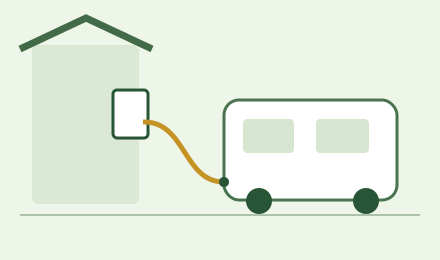
A suitable nearby wall may keep the connection close to the RV.
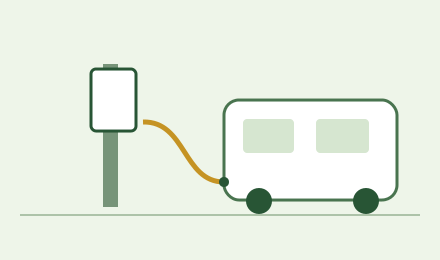
A separate support can bring the outlet to the parking position.
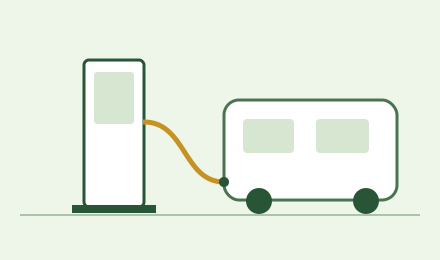
A dedicated assembly can suit a remote space with a planned supply route.
Electrical approval and permission to park or occupy an RV are separate questions. Confirm the property’s land-use and association requirements before finalizing the outlet location. Added length, supports and restoration can all change when the parking position changes.
Mister Safety’s RV service focuses on home shore-power installations. Electrical work does not itself authorize campground development, RV occupancy or rental use, and it is not RV-system repair.
Shore power is electricity supplied to the RV from a fixed connection outside it. The receptacle is the part the shore cord plugs into. The enclosure and cover protect that connection for its location. The circuit carries power from the property’s electrical equipment to the outlet. These parts must be planned together.
TT-30 and 14-50 describe different connections. A TT-30 normally supplies one 120-volt leg; the usual home 50A arrangement supplies two 120-volt legs. The RV’s actual equipment information tells us which connection to plan. A plug that fits does not tell us the condition of the circuit.
The parking location matters too. A short route beside a suitable wall is a different project from a pedestal across the yard. Neither distance nor an empty breaker space is enough to choose the installation. Start with your RV and where it will sit; the estimate should explain the rest.
A standard NEMA TT-30 supply is nominal 120 volts. It must not be treated as a dryer connection because both may say 30A.
Not automatically. The evaluated service capacity, existing loads, panel condition and proposed installation determine the scope.
The NEMA pattern alone does not approve EV use. The exact receptacle model, circuit, protection and vehicle-charger instructions matter. Some 14-50 product instructions specifically do not recommend EV charging.
No occupancy permission is established by electrical approval alone. Confirm the property’s separate parking, zoning, occupancy and association requirements.
A free estimate prices defined installation or upgrade work. Investigating an unexplained fault is paid diagnostics, with the charge explained and approved before troubleshooting.
Your RV. A defined scope.
Tell us about your RV, its parking location and the connection you want installed.
A free estimate prices defined installation or upgrade work. Investigating an unexplained fault is paid diagnostics; the charge is explained and approved before troubleshooting.
Understand diagnostic visitsBased in Zephyrhills and the Tampa Bay area. We confirm availability for your Florida service address and project.
Our office answers 24/7. View scheduling and fee details. Submitting a request does not confirm an arrival time.
Read our current limited-warranty terms. Equipment and qualifying workmanship have different coverage conditions.
Research reviewed September 12, 2026. Exact equipment instructions, property conditions and applicable code and jurisdiction govern the installation.
Leviton · Undated current catalog
Leviton · No issue date displayed; current linked revision
Leviton · Undated current catalog
Leviton · No issue date displayed; current linked revision
Eaton · Undated current catalog
Pasco County · Revised 2025-11-08; approved 2025-11-14
Mister Safety · Undated current resource
Mister Safety · Undated current resource
Leviton · 2020 NEC guide; site copyright 2023
Eaton · 2020
Leviton · 2020 NEC guide; site copyright 2023
Florida Building Commission · Current portal; stated effective date 2023-12-31
City of Tampa · Document updated 2024-01-18
Pasco County · Undated current guidance; references 2026-02-27 education-period end
Pasco County · Undated current guidance
City of Zephyrhills · Undated current page
City of Tampa · Undated current guide
Hillsborough County · Undated current portal
City of Lakeland · Undated current guidance
City of Orlando · Undated current guide
Florida Department of Health · Undated current guidance
Mister Safety · Undated current page