A defined installation
You know what you want installed or replaced. Start with a free estimate for that scope.

When an electrical problem has an unknown cause, diagnostics helps connect what you noticed with the evidence. Mister Safety explains the findings, the limits and your next options—so you can decide what to do next.
Diagnostics is paid. The charge and scope are explained before you approve testing.
An estimate prices work that is already defined. A diagnostic investigates a problem whose cause is not yet known. A broader safety inspection has its own agreed assessment scope.
You know what you want installed or replaced. Start with a free estimate for that scope.
Something has stopped working or changed. Finding the cause through testing is paid diagnostic work.
You want to understand accessible electrical conditions more generally. Ask about a safety inspection and its scope and fee.
A hands-off visual look helps the electrician understand the situation and explain whether an estimate or further investigation is appropriate. It is not troubleshooting and cannot establish hidden conditions.
You may decline a diagnostic and request defined work where safe and appropriate. Without investigating an unknown cause, a requested replacement cannot be promised to resolve it.
Sources: Mister Safety · Get a Free Estimate / Contact — estimate and diagnostic policy
A focused investigation starts with your account of the problem. The electrician selects appropriate checks for the equipment, conditions and approved scope. Every visit does not require the same tests.
We ask what happened, where and when. Your history helps focus the investigation, even if the symptom is absent.
The charge and scope are explained before testing. Identify the person who can approve the work.
The electrician selects accessible observations, measurements or tracing suited to the problem and agreed work.
Understand what the evidence supports, what could not be evaluated and whether more access or information is needed.
Review the options and any additional charge before approving further work. A repair is not automatically included.
Sources: Mister Safety · Get a Free Estimate / Contact — estimate and diagnostic policy / Klein Tools · ET450 Instruction Manual, document 1390483ART / Fluke · Fluke 117 Electrician's Multimeter
Accessible observations, electrical measurements and circuit tracing can help narrow the possibilities. They are interpreted together with the history of the problem. One reading, indicator light or photograph cannot answer every question about an electrical system.
A measurement describes a condition at the place and time checked. The instrument, method and operating conditions matter.
Tracing can help identify a circuit or follow a signal. It does not reveal the condition of every concealed connection.
Accessible checks have boundaries. If a concealed area needs further investigation, discuss the access and work before the scope expands.
A plug-in receptacle tester indicates only the conditions its exact model is designed to recognize. For example, the Klein RT210 manual excludes grounding quality and certain combinations of defects from what it can establish.
Likewise, absence of a non-contact voltage indication does not prove that equipment is safe to touch. These are examples of instrument limitations, not homeowner testing instructions or a list of tools promised for your visit.
Sources: Klein Tools · ET450 Instruction Manual, document 1390483ART / Klein Tools · RT210 Instruction Manual, document 1330234ART / Fluke · Fluke 117 Electrician's Multimeter
A normal reading during the appointment does not, by itself, establish that an earlier problem has ended. If the symptom is absent, the available evidence may be incomplete. Your timeline helps explain what the electrician cannot observe at that moment.
Tell us the affected areas, approximate timing and duration, and any ordinary circumstances you already noticed. Do not recreate the problem or repeatedly reset equipment to provide evidence.
“The kitchen lights flickered twice yesterday evening. Other rooms seemed normal. It is not happening now.”
A short description is enough to start. Do not recreate a fault or test equipment to complete a log.
Some professional instruments record events over time instead of taking a single spot reading. A suitable recording plan may help capture an event, but does not guarantee that it will occur or identify its origin.
Ask whether further observation, monitoring or another visit is appropriate and available. Its scope, equipment, duration and charge must be agreed; do not assume it is included in the initial diagnostic visit.
Sources: Florida Power & Light · Power Disturbances — Troubleshooting / Fluke · Fluke VR1710 Single Phase Power Quality Recorder
Ask what was reported, what was observed, what was checked and what the findings support. An honest explanation also identifies what remains uncertain. Select a possible outcome below to see how the next conversation can differ.
Ask what the proposed repair is intended to address, what is included and what it costs. A small repair may be possible within the diagnostic scope; other work may require separate approval.
The symptom may be absent, or an area may be inaccessible. Ask what an additional investigation could establish, what access it needs and what it would cost. Further observation or another visit is not automatically included.
Some findings may call for the serving utility, equipment manufacturer or another appropriate specialist. Ask what information to share and who is responsible for the next step. Do not approach utility equipment yourself.
Possible outcomes, not promised results. Further paid work requires the applicable approval.
Ask when arranging the visit how the findings and options will be shared. Keep the explanation and any approved scope for your records. Do not assume that every visit includes a separate formal report, photographs or a safety certificate.
If additional access is proposed, discuss what must be opened, who is responsible for restoration and what charges apply before authorizing that work.
Sources: Mister Safety · Get a Free Estimate / Contact — estimate and diagnostic policy
We explain the diagnostic charge and scope before you approve testing. Requesting a visit does not authorize that charge. After the findings are explained, review any additional work and its price before deciding.
A small repair may be possible during the diagnostic at the electrician’s discretion, depending on the findings, scope and conditions. It is not guaranteed; additional materials or repair work may need a separate proposal.
A diagnostic discount may apply to an eligible same-day, higher-priced approved project. It is conditional, not an automatic credit or a promise of free diagnostics.
When a qualifying discount applies, the affected work has a one-year limited warranty instead of the usual three-year term for qualifying supplied parts and workmanship. The discount amount, total and resulting warranty terms are explained before approval. Manufacturer equipment coverage is separate.
Sources: Mister Safety · Get a Free Estimate / Contact — estimate and diagnostic policy / Mister Safety · Warranty
Mister Safety is based in Zephyrhills and the Tampa Bay area. Share your Florida service address so the office can confirm availability and the appropriate visit. Different properties have different utilities, access arrangements and permitting authorities. For an Orlando home served by OUC, a suspected supply problem can also be reported to OUC. Keep any case reference for Mister Safety; a utility report alone does not diagnose the home’s wiring.
Use the provider on your electric bill. Neighbors having power does not conclusively rule out a utility-side issue. Share any utility case reference or findings.
Tell the office about flooding or other water exposure. A dry appearance does not establish that affected equipment can safely return to service.
Identify the site contact and the person who can authorize work. Mention access hours, tenants or operations that need coordination.
Electrical requirements depend on the jurisdiction and actual work. Florida’s published baseline is the 8th Edition (2023) Florida Building Code; Tampa’s adopted-code notice identifies the 2020 NEC. The applicable edition and authority must be rechecked for the project.
Do not assume a low repair price makes electrical work permit-exempt. Confirm the scope with the applicable local authority. If further access disturbs painted surfaces in covered pre-1978 property, lead-safe renovation requirements may also apply. Discuss the access, appropriate qualifications and restoration before approving it.
Sources: Florida Power & Light · Power Disturbances — Frequently Asked Questions / Electrical Safety Foundation International · Water-Damaged Electrical Equipment / Florida Building Commission · Florida Building Code information and updates / City of Tampa, Construction Services · Adopted Codes / Florida Senate · 2026 Florida Statutes, section 553.79 — Permits; applications; issuance; inspections / Pasco County · Permits and Forms / U.S. Environmental Protection Agency · Lead Renovation, Repair and Painting Program
You do not need to identify a failed part. Write down what happened and gather existing records. Our preparation guide explains what helps, how to arrange ordinary access and what to ask after the visit.
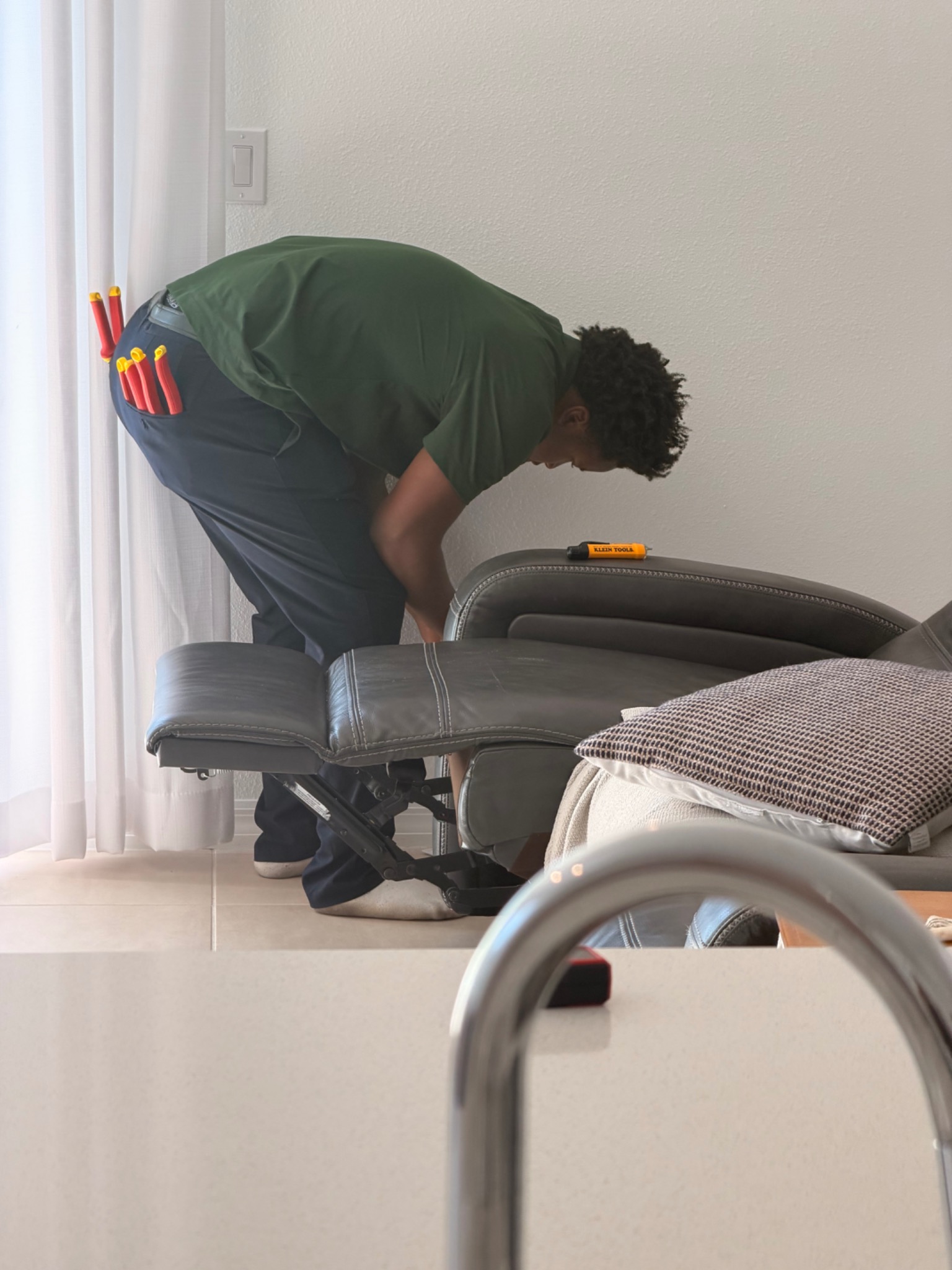
The electrician selects the appropriate checks. You do not need to identify a failed component or perform electrical tests before the visit.
Patrick on a Mister Safety home service visit.Sources: Florida Power & Light · Power Disturbances — Troubleshooting
For guidance about a particular symptom, use the existing Electrical Repairs guides. Diagnostics explains how an unknown cause is investigated.
The symptom is what you notice: an outlet stops working, lights change brightness, or power comes and goes. The diagnosis is the explanation supported by the investigation. The repair is the work you approve to address a supported finding. They are related, but separate, steps.
An estimate is a price for work that is already defined. Diagnostics is paid work to investigate an unknown cause. You review the diagnostic charge and scope before testing begins; asking for a visit does not approve a charge.
Testing is like gathering pieces of a picture. A measurement shows conditions at one place and time. Tracing helps follow a circuit. If a problem is not happening during the visit or an area cannot be accessed, some pieces may still be missing. A normal result does not automatically mean the earlier problem is gone.
Your part is to explain what you already noticed and arrange safe, ordinary access. The electrician’s part is to select appropriate checks and explain what they show. You can then ask what remains uncertain, what the next option is meant to address and what it would cost before deciding.
Sources: Mister Safety · Get a Free Estimate / Contact — estimate and diagnostic policy / Klein Tools · ET450 Instruction Manual, document 1390483ART / Fluke · Fluke 117 Electrician's Multimeter
No. A free estimate prices defined installation or upgrade work. Investigating an unknown electrical cause is paid diagnostic work, with the charge and scope explained for approval before testing.
No. Requesting or arranging a visit is not approval to begin charged testing. Review the diagnostic scope and charge before you decide.
A small repair may be possible at the electrician’s discretion, depending on the findings, scope and conditions. It is not guaranteed. Other work or materials may need a separate proposal; confirm what is included before approval.
Tell us that the symptom has stopped and describe the earlier events. The history can still help, but the available evidence may be incomplete. Ask what remains uncertain and whether further investigation is proposed.
No single indication establishes every condition in an electrical system. A test has a specific purpose and scope. Ask which checks were performed and what their limits are.
That cannot be determined from a general inquiry. If further access is needed, discuss the proposed scope, charge and restoration responsibility before authorizing it.
Ask when arranging the visit how the findings and options will be provided. The format depends on the agreed service; do not assume a separate formal report or safety certificate is included.
Diagnostics focuses on a particular problem or unknown cause. A safety inspection considers the property within an agreed assessment scope. Tell the office your goal so it can help route the request.
Sources: Mister Safety · Get a Free Estimate / Contact — estimate and diagnostic policy / Klein Tools · ET450 Instruction Manual, document 1390483ART / Klein Tools · RT210 Instruction Manual, document 1330234ART
Describe the problem in your own words. We’ll contact you to discuss the next step and confirm availability for your address.
Unknown-fault investigation is paid diagnostic work. The charge and scope are explained before you approve testing. Requesting a visit does not authorize a charge.
See visit and diagnostic policy details.Based in Zephyrhills and the Tampa Bay area, serving Florida addresses by confirmed availability.
Our office answers 24/7. A request is not a confirmed appointment. Arrival windows describe expected arrival, not the duration or outcome of a visit.
Already have an appointment? Use the preparation guide without submitting another request.
Research reviewed September 11, 2026. General education cannot diagnose your property. Exact equipment instructions, site conditions and applicable local requirements govern the work.
Mister Safety · Undated live page · Reviewed September 11, 2026
Klein Tools · No publication date established in inspected manual · Reviewed September 11, 2026
Fluke · Undated product page · Reviewed September 11, 2026
Klein Tools · No publication date established in inspected manual · Reviewed September 11, 2026
Florida Power & Light · Undated utility page · Reviewed September 11, 2026
Fluke · Undated product page · Reviewed September 11, 2026
Mister Safety · Undated live page · Reviewed September 11, 2026
Florida Power & Light · Undated utility page · Reviewed September 11, 2026
Electrical Safety Foundation International · No publication/update date established · Reviewed September 11, 2026
Florida Building Commission · Live page; identifies December 31, 2023 effective date · Reviewed September 11, 2026
City of Tampa, Construction Services · Updated January 18, 2024, printed on document · Reviewed September 11, 2026
Florida Senate · 2026 compilation · Reviewed September 11, 2026
Pasco County · Undated live page · Reviewed September 11, 2026
U.S. Environmental Protection Agency · No publication/update date established · Reviewed September 11, 2026
U.S. Fire Administration / FEMA · No publication/update date established · Reviewed September 11, 2026
Florida Power & Light · Undated utility page · Reviewed September 11, 2026