Before excavation
Confirm the route, access, locate responses and responsibility for private lines.

From the supply to the parking space
A distant parking area can change the wiring, route and excavation scope. The plan needs the actual cable path, intended RV supply and load, and conditions along the way. Voltage drop, underground services and restoration all belong in the discussion.
Defined installation estimates. Clear charges before paid diagnostic work.
Straight-line distance across the yard may understate the installed path. Building access, vertical runs, corners, obstacles and final outlet position all add context. An approximate distance is useful for the first conversation; it is not a cable specification.
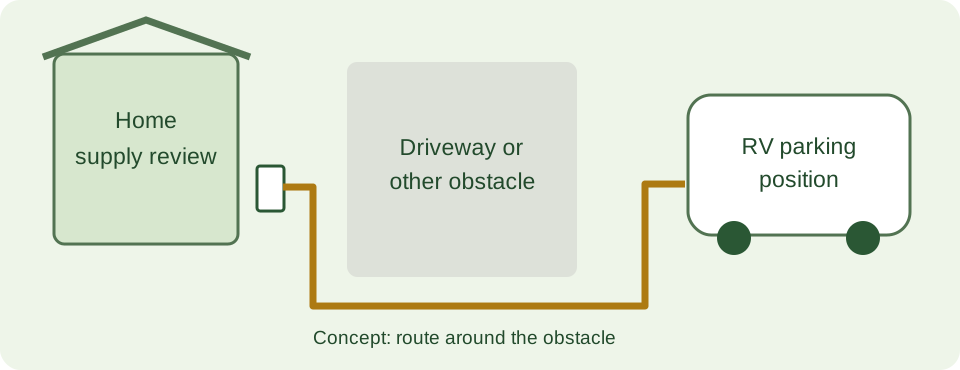
A longer path around a driveway or obstacle may be more practical than the shortest line. Compare access, work and restoration before committing to a route.
Voltage drop is the reduction in voltage along a loaded circuit. It depends on load, distance, conductor characteristics and supply voltage. Those variables are why “100 feet” alone does not settle the wire size.
Conductor ampacity, allowable terminations, grounding, protection, wiring method and installation conditions still matter. A calculator result is one part of design review. A larger conductor may also require an appropriate termination or transition plan.
Contact Sunshine 811 before excavation and check the utility responses. Member utilities mark the facilities they own; customer-owned electrical lines, irrigation and other private facilities may require separate locating.
Sunshine 811’s ordinary advance-notice period is at least two full business days, excluding the request day, weekends and holidays. Follow the current requirements and response process for the actual work; submitting a request is not proof that every line has been found.
Burial cover, underground wet-location suitability, raceway transitions, physical protection and inspections before concealment depend on the chosen method and location. There is no single trench-depth or wire-size answer for every Florida RV project.
A remote outlet does not automatically require a new meter or service upgrade. If work affects the service or utility connection, confirm the property’s actual provider and requirements. A mailing city alone does not select the utility.
The written proposal should allocate the work around the electrical installation. Confirm who handles utility coordination, any private locating, excavation or boring, and surface restoration. Specific services and exclusions are agreed for the project.
Confirm the route, access, locate responses and responsibility for private lines.
Define trenching or boring, crossings, supports and inspection timing.
Describe backfill, compaction, lawn or hardscape restoration and exclusions.
The farther power needs to travel, the more the actual route matters. The best plan is not always the shortest line drawn on a photo; it must work around the property and the things underground.
The electrician uses the RV’s requirements and route to design the circuit. You can help by describing the parking area and surfaces already visible. You do not need to dig, probe, open equipment or take live measurements. Agree on where the work goes and what gets restored before excavation begins.
Distance alone does not settle it. The RV supply, load, wiring method, conductor properties, termination limits and installation conditions must be evaluated together.
The selected wiring method and actual location determine applicable cover and protection. A universal depth would omit conditions that can change the answer.
No. Member utilities mark the facilities they own. Customer-owned electrical lines and other private facilities may require separate locating.
Do not treat chained cords as a permanent installation solution. Follow the actual RV and cord instructions and plan suitable fixed power for the intended use.
The written estimate must identify any restoration included, who handles it and what is excluded.
No. Circuit-route design and available service capacity are different questions.
Your RV. A defined scope.
Tell us the approximate distance, parking location and whether the route crosses lawn, pavers or a driveway.
A free estimate prices defined installation or upgrade work. Investigating an unexplained fault is paid diagnostics; the charge is explained and approved before troubleshooting.
Understand diagnostic visitsBased in Zephyrhills and the Tampa Bay area. We confirm availability for your Florida service address and project.
Our office answers 24/7. View scheduling and fee details. Submitting a request does not confirm an arrival time.
Read our current limited-warranty terms. Equipment and qualifying workmanship have different coverage conditions.
Research reviewed September 12, 2026. Exact equipment instructions, property conditions and applicable code and jurisdiction govern the installation.
Southwire · Undated current tool
Mister Safety · Undated current resource
Leviton · No issue date displayed; current linked revision
Leviton · No issue date displayed; current linked revision
Sunshine 811 · Undated current guidance
Sunshine 811 · Undated current guidance
Pasco County · Revised 2025-11-08; approved 2025-11-14
Tampa Electric · Undated current portal
Mister Safety · Undated current resource
Keystone RV · Undated current guide